recipe
Pudim de leite: Brazilian caramel custard
A gently baked condensed milk custard in a caramel-lined ring mold, with US pan guidance, a water bath and clear chilling and unmolding steps.
AI editorial review: 2026-10-22
Researched recipe; not cooked or tested by Culinara.
Jump to ingredients and methodPrint using your browser’s Print command.
Ingredients and method
Approximately 12 small slices; allow at least 6 hours to chill, preferably overnight
Ingredients
- For the caramel: 1 US cup granulated sugar (about 200 g)
- For the caramel: 1/3 US cup water (about 80 mL)
- 2 cans full-fat sweetened condensed milk, 14 ounces / 397 g each; two Brazilian 395 g cans also fit this batch
- 2 1/2 US cups whole milk (about 590 mL)
- 4 large eggs
- Boiling water for the baking water bath, separate from the caramel water
Method
- Set an oven rack in the middle and heat to 325°F. Use a one-piece metal tube or flan mold about 9 inches across, at least 3 inches deep and at least 10 cups in capacity, plus a roasting pan that holds it with space around the sides. The mold must have a sealed bottom, not a removable base or springform seam. Have a fine-mesh sieve, a thermometer, dry oven mitts and a rimmed serving platter ready.
- Make the caramel. Put the sugar and 1/3 cup water in a light-colored saucepan. Stir over low heat just until the sugar dissolves, then raise to medium and bring to a boil. Stop stirring once it boils. Watch closely as the syrup changes from clear to golden and then amber; remove it from the heat before it becomes very dark or smells burnt. Hot caramel burns severely: do not taste it, touch it or add liquid to it.
- Set the dry metal mold on a heatproof surface and carefully pour in the caramel. Wearing dry oven mitts, gently tilt the mold to spread it across the bottom and a little way up the sides, including around the center tube. The metal becomes hot. Set it down and let the coating firm for about 10 minutes while you mix the custard.
- In a large bowl, gently whisk the eggs just enough to combine the whites and yolks. Slowly stir in the condensed milk, then the whole milk. Avoid whipping air into the mixture. Let it stand for a few minutes, then pour through the sieve into the caramel-lined mold. Do not taste the uncooked custard; wash hands and equipment that touched raw egg.
- Place the filled mold inside the roasting pan. Move the assembly onto the oven rack, then carefully add boiling water to the roasting pan until it reaches halfway up the outside of the mold. Keep water out of the custard and slide the rack in gently. Bake uncovered. Start checking at 75 minutes; about 90 minutes is a planning estimate, and some pans and ovens will need longer.
- Check both temperature and texture. The custard must reach at least 160°F in its thickest part, between the center tube and outer wall, without the thermometer touching metal. Its edges should be set and the center should wobble gently as one mass rather than slosh like liquid. If the temperature is lower or the center is still liquid, continue baking and check again. It should not be rigid all the way through.
- When done, carefully lift the mold from the water bath with dry oven mitts and set it on a rack; leave the hot bath to cool before moving or emptying it. Let the custard cool for about 30–60 minutes, then refrigerate promptly, loosely covered at first and fully covered once cold. Get it into the refrigerator within 2 hours of leaving the oven, or within 1 hour if the room is above 90°F. Chill at 40°F or below for at least 6 hours, preferably overnight.
- Unmold the cold custard shortly before serving. Run a thin knife carefully around both the outer edge and the center tube. If it will not release, dip just the bottom of the mold in warm water for 10–15 seconds, then dry the outside. Put a rimmed platter over the mold, hold both firmly and invert together. Lift the mold after the custard releases; do not pound or force it. Spoon the liquid caramel from the mold over the custard and slice.
- Keep the custard covered and refrigerated, and finish within 3–4 days of baking. Return leftovers to the refrigerator promptly. Discard portions left out for more than 2 hours in total, or 1 hour above 90°F.
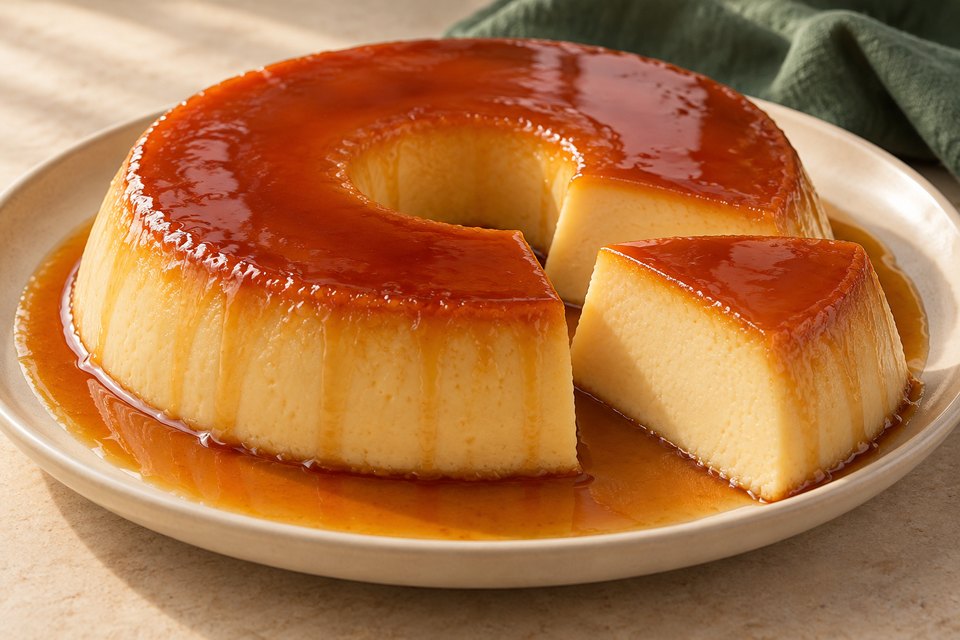
AI-generated illustration: Serving interpretation of milk-and-egg pudim with caramel, without vanilla or added garnish. Mold shape, caramel color and tiny custard pores may vary; appearance is not proof of doneness.
OpenAI · Usage terms
Image details
Original text-to-image output resized proportionally to 960×640 and JPEG-compressed; no crop or added ingredients.
Choose the mold before making caramel
A plain metal ring mold makes the shallow custard shape used here. Check its stated capacity as well as its diameter: a decorative cake pan can have very different proportions. A removable-bottom angel food cake pan or springform pan can leak custard into the bath and let bath water enter the dessert.
The rimmed platter matters too. Unmolding releases thin caramel sauce along with the custard, so a flat board or rimless cake stand can spill it. The recipe is intended for this single ring mold; small ramekins or a deep solid cake pan need different baking times.
A smooth custard, with a gentle mix
Pudim de leite is an egg-set caramel custard. This version keeps Panelinha’s balance of two cans of condensed milk, four eggs and 2 1/2 cups of milk, with a US oven setting rounded to 325°F. Its hand-mixing and straining method is intended to keep the interior mostly smooth.
Small holes do not by themselves mean a custard failed. Vigorous blending and harder heating can produce a more porous result; other Brazilian recipes deliberately use a blender and a hotter oven. Here, avoid a foamy mixture and use the water bath for gentler heating. A liquid center still needs more cooking even if the minimum safe egg temperature has been reached.
Use sweetened condensed milk, which contains added sugar. Evaporated milk is a different product and cannot replace it can for can. This formula uses whole dairy milk and large eggs; changing their amounts or substituting plant milk calls for a separate formulation.
Caramel that releases from the pan
The sugar and water start together in this wet-caramel method. Once boiling, leave the syrup alone and judge its color rather than promising an exact minute count. A light-colored saucepan makes that change easier to see. If the caramel blackens or smells acrid, let it cool safely and start again.
The coating hardens before the custard goes in; that is expected. Chilling is part of the release process as well as the texture: give the baked custard a full cold rest before turning it out. Warm the bottom briefly if it sticks, then try again. Caramel is the only topping needed here.
Make ahead and keep refrigerated
Plan to bake this the day before serving. Baking and cooling take additional time beyond the six-hour minimum refrigerator rest, and the bake estimate is not a tested Culinara timing.
Contains milk and egg. Use a thermometer for the 160°F egg-dish minimum, cool promptly and keep at 40°F or below. The 3–4-day refrigerated limit follows FDA guidance for cooked egg dishes. Do not leave the pan on the counter overnight or wait hours for a deep water bath to cool before refrigerating the custard.
Research sources
- Panelinha — Pudim de leite sem furinhos (checked 2026-10-22)
- Aline Shaw — Brazilian Flan Recipe, Brazilian Kitchen Abroad (checked 2026-10-22)
- Olivia Mesquita — Brazilian Flan, Olivia’s Cuisine (checked 2026-10-22)
- King Arthur Baking — An expert’s tips to nail your flan (checked 2026-10-22)
- King Arthur Baking — How to make caramel (without breaking a sweat) (checked 2026-10-22)
- FDA — What You Need to Know About Egg Safety (checked 2026-10-22)
- FDA — Are You Storing Food Safely? (checked 2026-10-22)